Open SubSpace

Open source · Rust · 0.1.x

SubSpace, written again from the wire up.

SubSpace is a top-down multiplayer space shooter from 1997. Ships drift; bullets and bombs carry your momentum with them; a map is 1024×1024 tiles of asteroid and wall, with flags to take and a team to take them from. When the publisher, Virgin Interactive Entertainment, walked away, the players kept it running themselves — and they still are.

Open SubSpace is that game rebuilt in Rust so that it outlives the binaries it grew up in: a new client, a zone server that runs existing zones unchanged, and a shared core anyone can build on. Not an emulator and not a fork — every packet, file format and physics rule implemented fresh, and checked against the software that is still running.

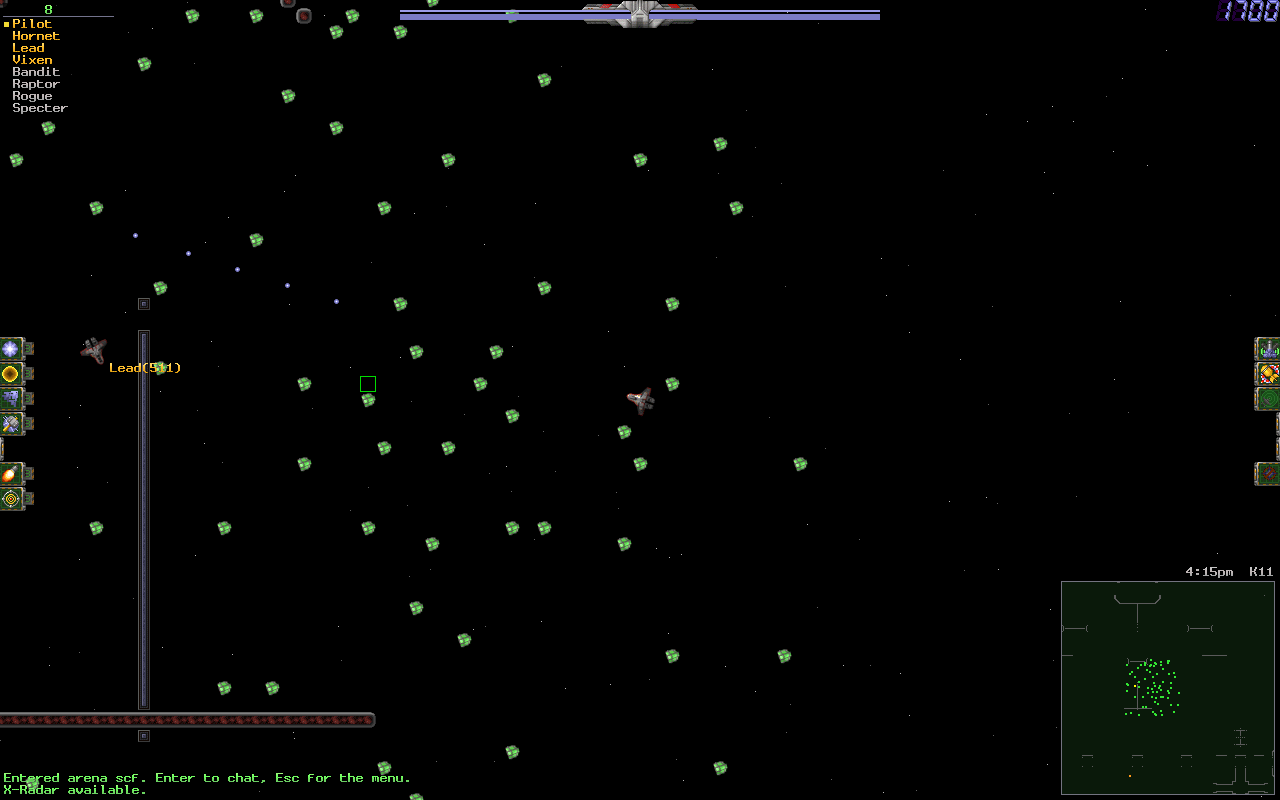
oss-client flying in the bundled zone: two ships among green prizes, with the ship list, radar and energy bar on screen
oss-client in the zone that ships with oss-server, taken with --screenshot.
Language
Rust 1.88 or newer; 1.89 for the server
Simulation
100 Hz integer physics
On the wire
SubSpace era and OpenSec, one port
Zones
ASSS directories, unchanged
Licence
MIT core, GPL client and server

01 Download

Ready to run, no toolchain needed

From 0.1.0-dev8, every release comes with the programs built for Windows, macOS and Linux. Each one is a download from its repository's releases page on GitHub: unpack it and run it.

Client

The game client

Log in to a zone and fly, or practise offline. Unpack the whole archive and keep its assets folder beside the program, which reads its graphics and sounds from there.

  • Windows x64
  • macOS Apple Silicon
  • Linux x64
oss-client releases

Bot

The headless bot

A client with no window, for checking a zone or putting load on one. It is its own archive, oss-bot, on the client's releases page.

  • Windows x64
  • macOS Apple Silicon
  • Linux x64
oss-client releases

Server

The zone server

Run it with no arguments and it serves its bundled zone on UDP port 5000. The archive also carries oss-biller, a small account database for a zone that wants one.

  • Windows x64
  • macOS Apple Silicon
  • Linux x64
oss-server releases

Conformance

The conformance tool

oss-conformance checks a SubSpace client, server, bot or library, written in any language, against the protocol.

  • Windows x64
  • macOS Apple Silicon
  • Linux x64
oss-core releases

Rather build it yourself? Everything here also builds from source with a Rust toolchain — the client, the server and the conformance tool each say how.

02 Source

Three repositories, one game

The split is deliberate. The core is MIT so that anyone's bot, tool or alternative client can build on it whatever its licence; the client and server are GPL so that the playable game and the server behind it stay open, and so does anything built from them.

oss-client

GPL-2.0-or-later

The game client. Cross-platform, runs at whatever resolution and refresh rate your display has, takes a gamepad, and needs no Continuum install to start. Plus oss-session and a headless bot.

oss-server

GPL-2.0-or-later

The zone server. Follows ASSS closely enough to take an existing zone directory and run it unchanged — same .conf files, maps, module names and ?commands — with SubSpace-era and OpenSec clients on one port.

oss-core

MIT

The shared half: packets, transport, map and settings formats, the physics simulation, a bot SDK and a conformance suite anyone can run against their own implementation.

03 Play

Download it and fly — or build it yourself

The quickest way in is the client from Download: unpack it and run oss-client.

To build it from source instead, you need a Rust toolchain (1.88 or newer). The client uses the shared crates as a sibling checkout, so clone both and run it:

Shell
git clone https://github.com/DangerMouseUK/oss-core
git clone https://github.com/DangerMouseUK/oss-client
cd oss-client
cargo run --release -p oss-client

Either way, it opens on the login screen: zone, name, password, arena, ship. F3 is the zone browser, F5 the offline sandbox. The keys are Continuum's, so a returning player already has them in their hands, and F1 in the game lists them — yours, if you have changed any. Joining a zone of your own? It prints the password you need when it starts — see Run a zone.

No zone to hand? Fly on your own: start the program with --sandbox, or from source:

Shell
cargo run --release -p oss-client -- --sandbox

Graphics and sounds come bundled, so it plays from the download or a fresh clone. Already have Continuum? --continuum-dir uses your own instead. The client contacts no directory server you have not configured. Keys, chat, macros and replays →

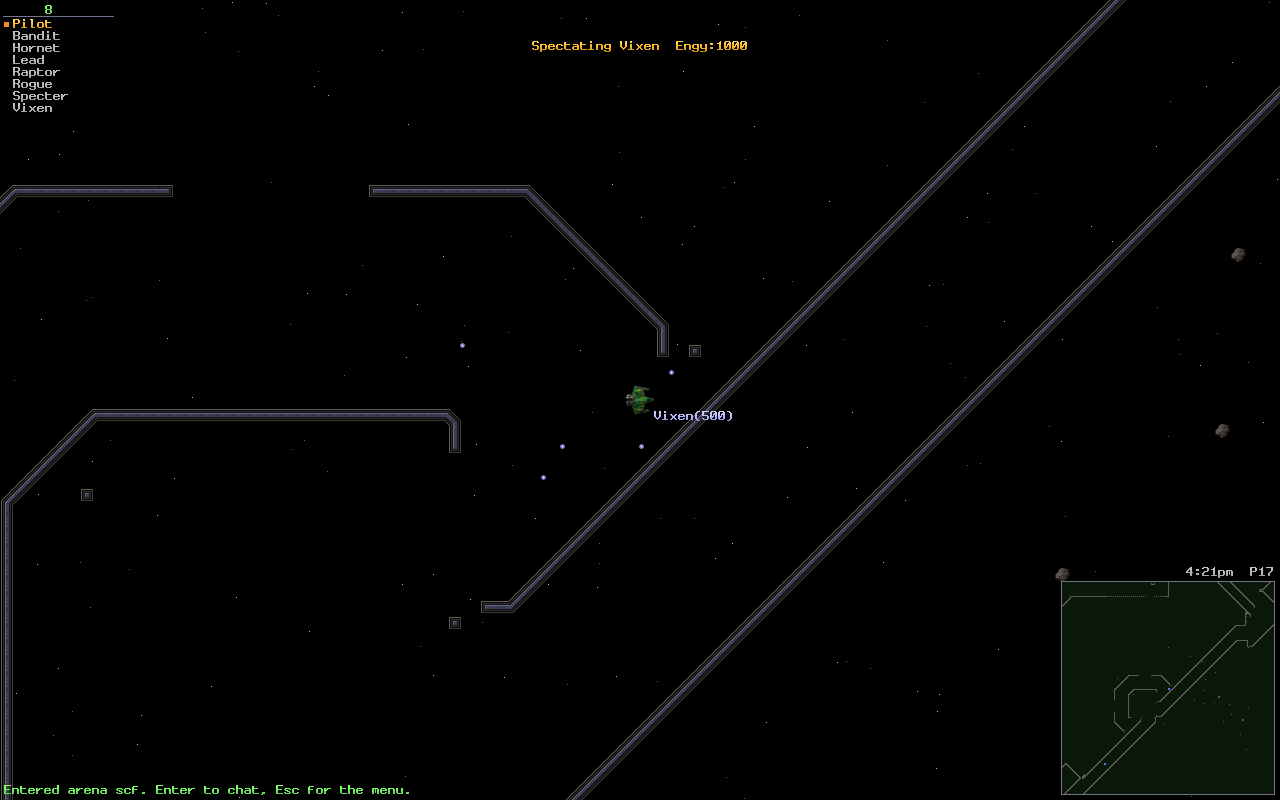
oss-client spectating another ship in the bundled zone
Spectating another ship.
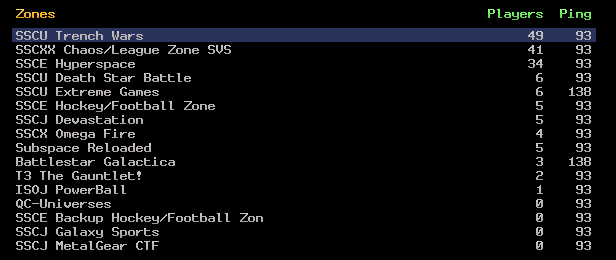
The zone browser listing live zones with population and ping
The zone browser (F3) listing live zones, after adding directory servers — the client ships with none.

04 Run a zone

One command, and you are a zone

With no arguments, oss-server runs its bundled zone — the ASSS 1.4.4 sample zone, compiled into the binary — on UDP port 5000, with the ping port on 5001. You are now a zone.

Take the server from Download and run it, or build it from source, which needs Rust 1.89 or newer:

Shell
git clone https://github.com/DangerMouseUK/oss-core
git clone https://github.com/DangerMouseUK/oss-server
cd oss-server
cargo run --release

It prints a password on start, and you need it to log in. A zone that has been given no login configuration of its own generates one, prints it once, and then admits any name that presents it — so copy it out of the server's output before you connect. A zone with a directory keeps it in conf/passwd.conf; the bundled zone, which writes nothing, makes a new one every time it starts. --zone-password <pw> sets your own instead.

Already run a zone? Point it at your directory, unchanged. The program is in the download, or at target/release/oss-server once cargo run --release has built it:

Shell
# run an ASSS-style zone directory
oss-server --zone <dir>
# write the bundled zone out as a starting point
oss-server --init-zone <dir>
  • ASSS's config reader: #include, sections, per-arena overrides.
  • SubSpace-era and OpenSec clients on one port. OpenSec is this project's own transport encryption — X25519 and ChaCha20-Poly1305 — tried first and falling back to the SubSpace-era cipher for anything that does not speak it, specified in full.
  • Every negotiated session is encrypted. The SubSpace-era cipher is the floor and nothing automatic goes below it: a peer that asks for an unencrypted session is declined rather than answered. Running in the clear is a development setting, off by default, that has to be set at each end separately — no zone can ask a client for it, and no client can ask a zone.
  • One process, structured logs, a JSON admin API and Prometheus metrics.
  • 43 modules in the tree, 34 of them loaded by the bundled zone; the ones ASSS has that this doesn't are named in conf/modules.conf.
  • A library first: a private or third-party build adds its own modules without patching the repository.
  • oss-biller: a small SQLite-backed SSC billing server for private and test zones.
  • Deployable: a container image, and a Linux install.sh with a hardened systemd unit that runs the zone as an unprivileged service account and starts nothing by itself — deployment, and what is checked. Both build from source; the image is published to no registry yet.
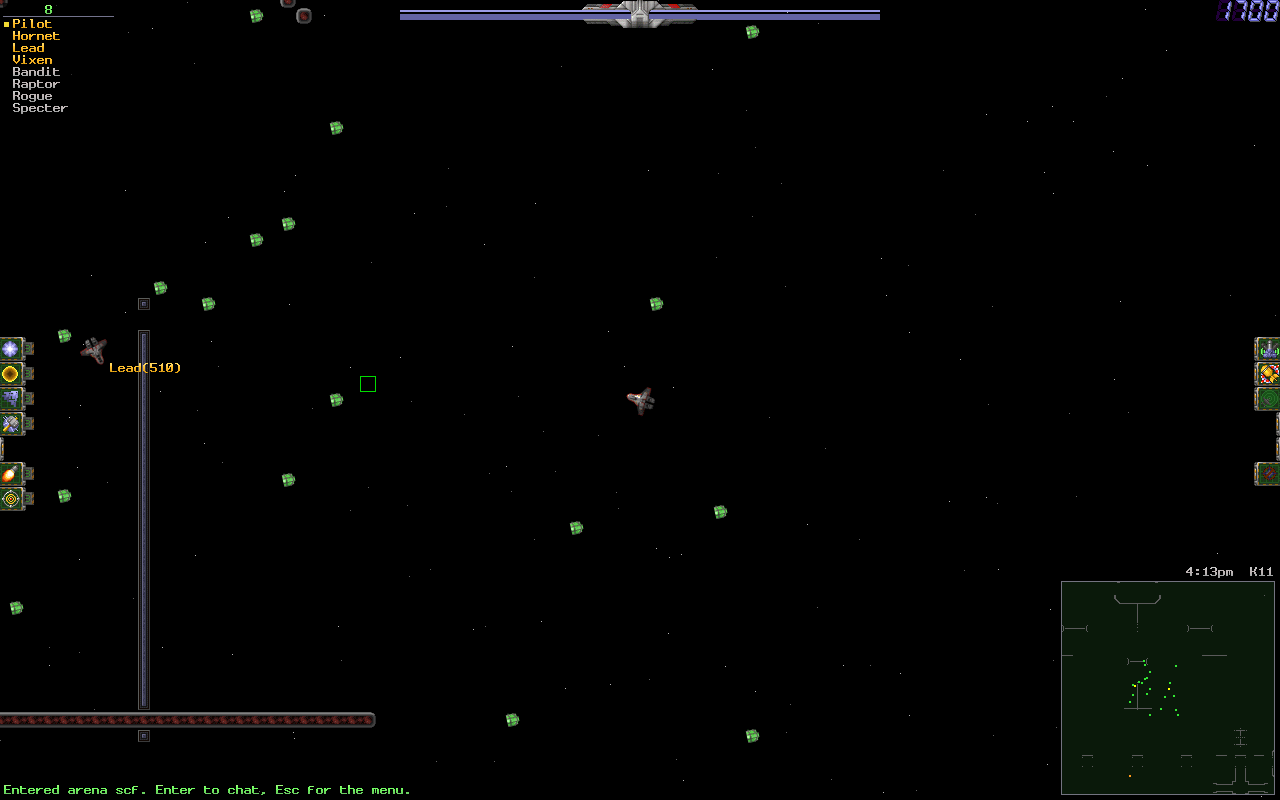
The bundled zone seen from oss-client, with eight players in arena scf
The bundled zone, running, with eight clients in it.

05 Build on it

A core with no game loop and no window

oss-core has no game loop and no window. It is what you reach for when you are writing a bot, a tool, a zone server or another client — in Rust directly, or in any language through the conformance suite's adapter protocol.

Bot SDK

A bot in about forty lines

The SDK handles the handshake, login, arena entry, map download and security challenge. Your code sees events — PlayerEntered, Chat, Kill — and replies.

Shell
cargo run -p oss-bot-sdk --example greeter -- \
    127.0.0.1:5000 GreeterBot password
Read greeter.rs →

Conformance

Check your own implementation

The conformance suite drives anything that speaks a line-based stdin/stdout protocol, in any language — and can stand in as a zone or a client to check live software. Take it ready to run from Download, or from source:

Shell
cargo run --release -p oss-conformance -- vectors -- python3 my_adapter.py
cargo run --release -p oss-conformance -- server 127.0.0.1:5000
The adapter protocol →

The crates in oss-core

  • oss-protoPacket types and codecs
  • oss-netSans-IO transport: reliability, clustering, file transfer, the SubSpace-era cipher and OpenSec
  • oss-formats.lvl, eLVL, .lvz, .ossr replays
  • oss-simDeterministic 100 Hz integer physics, shared by client and server
  • oss-bot-sdkZone bots in a few lines
  • oss-conformanceVector, live-client and live-server checks

06 Evidence

Why you would trust it

The project's habit is that a claim names its evidence. These are the ones worth checking first.

3,761recorded conformance checks, captured from unmodified reference implementations
846arena settings checked bit-for-bit against ASSS's own settings packet
12fuzz targets — every packet, map, LVZ and replay decoder, and the transport
~12%of one core for 500 players over a whole map, against a 20% budget

Interoperability

It plays with software nobody here wrote

A stock oss-client joined a zone running subgame, the original server software, and flew. The original 1998 SubSpace client logged in to oss-server, downloaded the news, entered an arena and flew. An unmodified, prebuilt MERVBot 4.6 completed a full session over the SubSpace-era cipher. A genuine Continuum 0.40 client logged in and flew on oss-server, with Continuum's key exchange supplied by a private module that is not in these repositories.

What has connected, and what each run did not cover →

Simulation

Prediction and anti-cheat are the same code

oss-sim is a fixed-step integer simulation with no floating point, used by the client to predict and by the server to validate — so the two cannot drift apart into false positives.

Every setting it reads, and its source →

Protocol

Every protocol page states its evidence level

One page per packet, each marked Vectors, Sources, Partly inferred, Project spec, Observed or Open. Where sources disagree the page says so rather than picking quietly. The three encryption eras — SubSpace era, Continuum era and OpenSec — are introduced on one page, where the SubSpace-era cipher appears under its own name, VIE, after the publisher.

The protocol docs →

Performance

Performance is measured — including where it falls short

500 players over a whole map fit the budget. In a crowded 500-player arena they cost about 27% of a core with the SubSpace-era cipher and 35% with OpenSec, and the budget does not close. That is written down rather than rounded away.

Method, machine and control runs →

07 Status

What works, and what does not

Working today

Client

  • Login and registration
  • Arena entry and ?go
  • Map/LVZ/news download with a cache
  • The full renderer and HUD
  • Flying and fighting with client-side prediction
  • Kills and scores
  • Public, team, private, channel and squad chat with Continuum's prefixes
  • Macros
  • The menu
  • Spectating and following
  • Turrets
  • The zone browser
  • Replays
  • A settings screen
  • Screenshots
  • Gamepads, with remapping
  • Colour-blind and high-contrast palettes
  • Interface scaling
  • An offline sandbox on any .lvl map

Server

  • Arenas
  • Freq manager
  • Ships and weapons with plausibility checks
  • Kills and scoring
  • Flags, warzone and turf
  • Balls and soccer
  • KOTH
  • Bricks
  • Prizes and ?buy
  • Banners
  • Chat with ASSS's flood rules and obscene filter
  • Chatnet
  • Capability groups
  • Bans and ?passwd
  • Persistence
  • LVZ objects
  • Map and news download
  • Lag data and ?lag
  • Periodic and turf rewards
  • The game timer
  • Directory registration
  • SSC billing
  • Hot reload
  • Module load/unload
  • Admin API and metrics

Not here, on purpose

Continuum's own encryption. Its key expansion is not public and these repositories do not carry it. That is deliberate rather than an oversight, and not a gap waiting to be filled: the piece is held back for now, with the reasoning recorded privately. It is an embargo and not a permanent secret — it stands while the reasons for it stand, and no longer. A client built from these repositories cannot join zones that require Continuum's encryption, and a Continuum client can play on oss-server only if that cipher module is supplied separately. Zones that accept the SubSpace-era cipher — including ASSS and the original server — and OpenSec zones are reachable. The security path is a trait, so a build that supplies its own cipher needs nothing here to change.

Not done yet

  • A stable release. The downloads are development builds, published as pre-releases, and none of them is signed yet. The server's container image is not published to a registry, and nothing is on crates.io.
  • A browser build. The renderer is kept WebGPU-compatible and the core crates build for WebAssembly, but the client is not built or tested there.
  • A crowd. It has been played against the original server software and its own — not yet by a hundred people at once. Live internet zones may still turn a client away on their own account policies.
  • A stable API. Everything is 0.1.x and moves when the evidence says it should. OpenSec has not yet had an external cryptographic review. If you are minded to give it one, the spec is complete and oss-core's security policy says how to report what you find.

08 Contribute

Bring a difference you can show

Issues and pull requests are welcome. The most useful thing you can bring is a difference from the original you can demonstrate — a setting that behaves differently, a packet that is mishandled, a frame that does not look right next to Continuum — with the evidence behind it.

Found a security problem? Please do not open an issue. Each repository takes private reports through GitHub's advisory form, and each says what it considers in scope: client · server · core · this website.